Openssl Generate Public Key From Rsa Private Key
- The command that you shared generates a public key pair from the existing private key. Openssl rsa -in server.key -pubout -out key.pub.
- Newer versions of OpenSSL say BEGIN PRIVATE KEY because they contain the private key + an OID that identifies the key type (this is known as PKCS8 format). To get the old style key (known as either PKCS1 or traditional OpenSSL format) you can do this: openssl rsa -in server.key -out servernew.key Alternately, if you have a PKCS1 key and want.
- Generating the Private Key - Linux 1. Open the Terminal. Navigate to the folder with the ListManager directory. Type the following: openssl genrsa -out rsa.private 1024 4. The private key is generated and saved in a file named 'rsa.private' located in the same folder. Generating the Public Key - Linux 1. Open the Terminal.
- Oct 09, 2019 OpenSSL has a variety of commands that can be used to operate on private key files, some of which are specific to RSA (e.g. Openssl rsa and openssl genrsa) or which have other limitations. Here we always use openssl pkey, openssl genpkey, and openssl pkcs8, regardless of the type of key.
- In principle, it would be possible to create an RSA private key from which the corresponding public key cannot be easily obtained, but this would require using both a non-standard key generation method and a non-standard private key storage format.
Verify downloaded file
RSA Public Key pad and encrypt
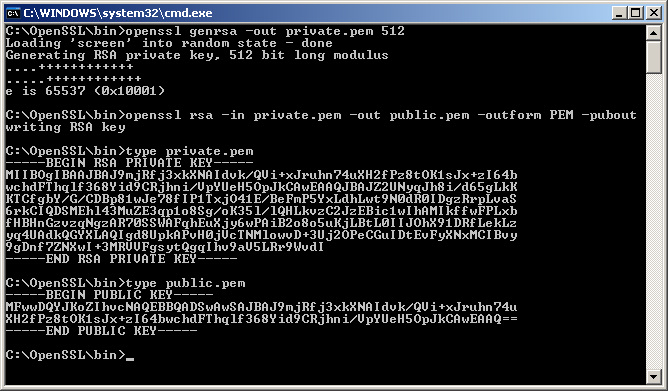
How to generate random number by using dev urandom; How to generate RSA public and private keys(PEM format) with openssl? How to generate RSA public private keys(PEM format) with openssl? How to generate SHA256 digest? How to install KScope for code trace; How to know kernel memory usage in proc meminfo, proc slabinfo.
Read ciphertext as Hex chars
Decrypt with RSA Private Key, from binary ciphertext
Decrypt with DES
Convert from ciphertext from hex to ciphertext
Base64 operations
Key Pairs
Convert private key file to PEM file
Print EC private key & extract public key
Read EC public key
Print RSA private key & extract public key
Print the entire certificate
Certificates
Downloaded the leaf certificate from Stackoverflow.com.
Print the entire certificate
Create own cert from Private key
Use own private key to generate a self-signed certificate with it. This command creates a self-signed certificate (domain.crt) from an existing private key (domain.key):
Extract Public Key from Cert as PEM file
Print public key only
Strip the Generic Header and Footer
Extract Public Key from Cert in Hex format
Nginx Self-Signed Cert
Nginx needed the Leaf's Private Key the Leaf's Certificate or a certificate chain.
Whichever choice, I always found PEM files worked better with OpenSSL.
If you hit Expecting: TRUSTED CERTIFICATE error, check you actually chained the Certificates and NOT the Public Keys.
Apply the new Leaf Private Key and Certificate Chain:
This all worked fine with Firefox and Safari on macOS. But Chrome gave: Error: 'Subject Alternative Name Missing'. Despite having a trusted Cert Chain (Root CA, Int CA), Chrome stopped the page loading.
Openssl Rsa Public Key From Private Key
To re-generate the files required by Nginx, I used the same Root CA, Int CA and focused on a new leaf that had a Subject Alternative Name. I used Keychain. See the picture below.
Reference
- Related Questions & Answers
- Selected Reading
OpenSSL is a CLI (Command Line Tool) which can be used to secure the server to generate public key infrastructure (PKI) and HTTPS. This article helps you as a quick reference to understand OpenSSL commands which are very useful in common, and for everyday scenarios especially for system administrators.
Certificate Signing Requests (CSRs)
If we want to obtain SSL certificate from a certificate authority (CA), we must generate a certificate signing request (CSR). A CSR consists of mainly the public key of a key pair, and some additional information. Both these components are merged into the certificate whenever we are signing for the CSR.
While generating a CSR, the system will prompt for information regarding the certificate and this information is called as Distinguished Name (DN). The important field in the DN is the Common Name (CN) which should be the FQND (Fully Qualified Domain Name) of the server or the host where we intend to use the certificate with.
The next item in a DN is to provide the additional information about our business or organization. If we purchase an SSL certificate from a certificate authority (CA), it is very important and required that these additional fields like “Organization” should reflect your organization for details.
Here is a general example for the CSR information prompt, when we run the OpenSSL command to generate the CSR.
We can also provide the information by non-interactive answers for the CSR information generation, we can do this by adding the –subj option to any OpenSSL commands that we try to generate or run.
Below is an example for the –subj option where we can provide the information of the organization where we want to use this CSR.
Generating CSRs
In this section, we will cover about OpenSSL commands which are related to generating the CSR. This CSR can be used to request an SSL certificate from a certificate authority.
Generate a Private Key and a CSR
If we want to use HTTPS (HTTP over TLS) to secure the Apache or Nginx web servers (using a Certificate Authority (CA) to issue the SSL certificate). Also, the ‘.CSR’ which we will be generating has to be sent to a CA for requesting the certificate for obtaining CA-signed SSL.
Below is the command to create a 2048-bit private key for ‘domain.key’ and a CSR ‘domain.csr’ from the scratch.
The ‘–newkey rsa:2048’ is the option which we are specifying that the key should be 2048-bit using the RSA algorithm. The ’ –nodes’ option is to specifying that the private key should not be encrypted with a pass phrase. The ‘-new’ option, indicates that a CSR is being generated.
Generate a CSR from an Existing Private Key
Here we will learn about, how to generate a CSR for which you have the private key.
Below is the command to create a new .csr file based on the private key which we already have. Rocket league free keys xbox one generator.
Generate a CSR from an Existing Certificate and Private key
Here we can generate or renew an existing certificate where we miss the CSR file due to some reason. Here, the CSR will extract the information using the .CRT file which we have.
Below is the example for generating –
Where -x509toreq is specified that we are using the x509 certificate files to make a CSR.
Openssl Generate Public Key From Rsa Private Key Code
Generating a Self-Singed Certificates
Here we will generate the Certificate to secure the web server where we use the self-signed certificate to use for development and testing purpose.
Here, we generate self-signed certificate using –x509 option, we can generate certificates with a validity of 365 days using –days 365 and a temporary .CSR files are generated using the above information.
Viewing the Certificates Files
Please note that, CSR files are encoded with .PEM format (which is not readable by the humans). This is required to view a certificate. In this section, we can cover the OpenSSL commands which are encoded with .PEM files.
Viewing CSR Files Entires
The below command will be used to view the contents of the .CRT files Ex (domain.crt) in the plain text format.
Working with Private Keys
Openssl Rsa Generate Public Key From Private Key
In this section, will see how to use OpenSSL commands that are specific to creating and verifying the private keys.
Create a Private Key
Below is the command to create a password-protected and, 2048-bit encrypted private key file (ex. domain.key) –
Generate Private Key Rsa
Enter a password when prompted to complete the process.
Generate Rsa Public Key
Verify a Private Key
Below is the command to check that a private key which we have generated (ex: domain.key) is a valid key or not
Openssl Generate Rsa Public Key From Private Key
If the private key is encrypted, you will be prompted to enter the pass phrase. Upon the successful entry, the unencrypted key will be the output on the terminal.
Openssl Generate Public Key From Rsa Private Key West
In this article, we have learnt some commands and usage of OpenSSL commands which deals with SSL certificates where the OpenSSL has lots of features. We will learn more features and usage in the future. I hope this article will help us to understand some basic features of the OpenSSL.